Our New Mobile Dental Unit: Treating Tartar and Gum Disease in Dogs and Cats Right at Your Door
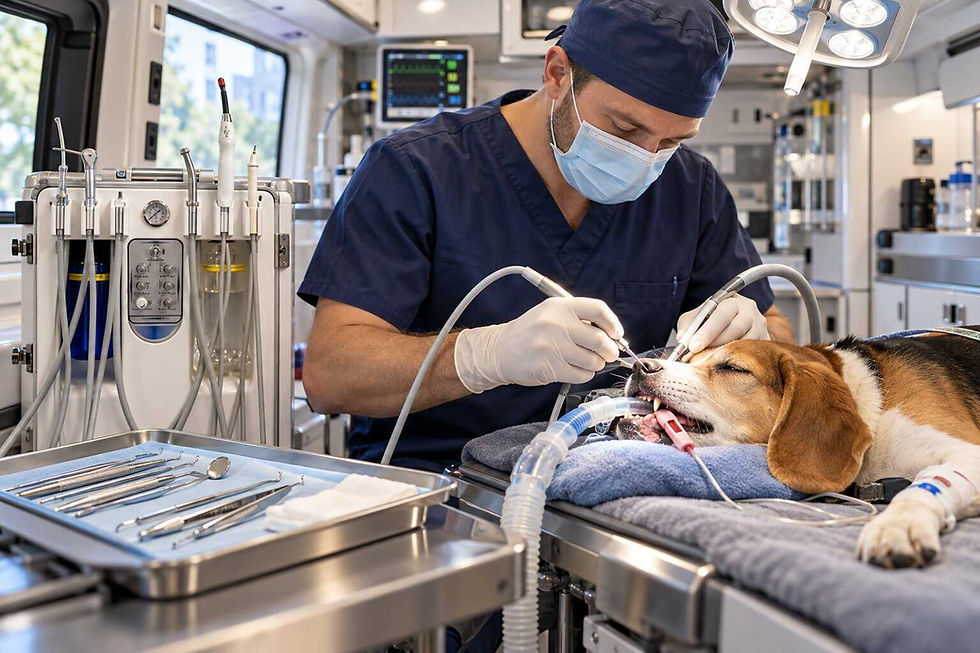
Bad breath, red gums, or a dog that suddenly chews only on one side. Dental problems are among the most common, and yet most overlooked, health issues in dogs and cats – because animals are remarkably good at hiding mouth pain.
That's why we've added a new mobile dental unit to our veterinary ambulance fleet. Tartar removal, treatment of gum inflammation or extraction of a damaged tooth can now be done right in our ambulance parked outside your home – no driving across the city and no stressful waiting room.
What is a mobile dental unit and what can it do?
In short: it's a veterinary dental station that we carry directly in the ambulance. It allows us to perform the same dental treatment you would otherwise get at a clinic.
The unit includes an ultrasonic scaler for tartar removal, a high-speed handpiece for dental work, enamel polishing, and suction with water and air supply. This means we can clean teeth not only above the gumline but also below it, where most inflammation starts.
You can find a full overview of the equipment in our vehicles on the veterinary ambulance equipment page.
Why do dental problems in dogs and cats matter so much?
Tartar isn't just a cosmetic issue. Bacteria in plaque gradually irritate the gums, leading to gum inflammation (gingivitis) and later periodontal disease, in which teeth become loose and fall out.
Untreated inflammation in the mouth also puts a strain on the whole body – bacteria can travel through the bloodstream to the heart, kidneys or liver. If your pet has already been diagnosed with a heart condition, read our article on heart murmurs in dogs and cats.
In cats we often see painful inflammation of the gums and teeth, while in young dogs a common issue is retained baby teeth that don't fall out on their own.
Symptoms to watch for
Pay attention if you notice bad breath, yellow-brown deposits on the teeth, red or bleeding gums, excessive drooling, chewing on one side only, refusing hard food, or pawing at the mouth.
Cats hide tooth pain even better than dogs. Often the only sign is that they start eating more slowly, drop kibble, or stop grooming themselves properly. For more subtle warning signs, see how to tell if your dog is in pain.
How does dental treatment in our ambulance work?
Treatment starts with an examination of the mouth and a general health check. Depending on your pet's age and health, we may also recommend a blood test, which we run right in the ambulance thanks to our own blood analyzer.
Thorough tartar removal, especially below the gumline, is performed under general anesthesia. Your pet feels nothing, stays still, and the vet can work carefully and safely. We monitor vital signs throughout the entire procedure.
After cleaning, we polish the teeth so that new plaque doesn't build up as quickly on the smooth surface. If a tooth is damaged or loose, we'll discuss its gentle removal with you.
Recovery takes place calmly in familiar surroundings – you receive your pet literally at your front door, and they recover in their own bed. Why a calm, smooth procedure matters most is something we also explain in our article How Much Does It Cost to Neuter a Cat?.
Dental care at home or at the clinic?
Both options share the same medical standard. The difference lies in how much stress and logistics you and your pet have to deal with.
With clinic treatment, you need to transport your pet, wait for them to wake up from anesthesia, and then drive them home while they're still drowsy. For cats, senior dogs with joint pain or anxious animals, the journey is often the hardest part of the day.
With the mobile dental unit, there's no travel and no waiting room. Transport is charged by the actual kilometers driven from Prague 2 (49–66 CZK/km depending on the vehicle), and the minimum price of a veterinary callout is 2,000 CZK including transport. We're happy to give you the price of the treatment itself in advance, and you'll find individual items in our price list.
If you'd rather come to us, we also offer dental treatment at our clinic in Prague 2.
Who benefits most from dental care in an ambulance?
We especially recommend mobile dental treatment for cats that handle travel in a carrier very poorly, and for older dogs and cats with limited mobility.
It's also a great fit for owners of large breeds that are hard to load into a car, and for multi-pet households, where we can check everyone's teeth during a single visit.
How do I book dental treatment?
You can book planned dental treatment through our veterinary ambulance request form. Just mention in the note that it's for dental care, and we'll suggest a suitable date.
Not sure whether your pet needs treatment? Start with a phone consultation – the vet will go through the symptoms with you and recommend next steps.
If your pet is in acute pain, has a swollen face or is bleeding from the mouth, don't hesitate to call our animal ambulance. When to act immediately is covered in our article Veterinary Emergency Care: When to Call an Ambulance.
Summary
Tartar and gum inflammation are among the most common health problems in dogs and cats, and without treatment they cause long-term pain. Thanks to our new mobile dental unit, we can treat them under anesthesia right in the ambulance outside your home – no travel, no waiting room, and recovery in familiar surroundings.
A dental check at least once a year and timely tartar removal are the best prevention to keep your pet's mouth healthy and their life happy.
You can book a veterinary home visit here.
You can request a veterinary ambulance (for acute cases) here.
You can book an appointment at our clinic in Prague 2 here.
You can book a remote phone consultation here.
Note: All information provided on this website is for educational purposes only. None of the information here is intended to replace a medical diagnosis and should not be considered medical advice or a recommended treatment.
* Image source: ChatGPT
