✅ CZK 1,000 deposit when you book online
✅ For neutering at home, travel fee by ambulance type (CZK 49-66/km)
✅ Total price per our transparent price list (see below)
✅ After the surgery you only pay the rest (card, QR payment or cash).
Cena kastrace
ActPriceSpaying of female cat up to 4 kg5,000 CZKSpaying of female cat 4+ kg6,000 CZKTomcat neutering2,500 CZKSpaying of female dogs (1-10 kg)10,000 CZKSpaying of female dogs (11-30 kg)12,500 CZKSpaying of female (31+ kg)15,000 CZKDog neutering (1-10 kg)5,000 CZKDog neutering (11-30 kg)6,500 CZKDog neutering (31+ kg)8,000 CZKChemical castration (dog or cat up to 30 kg)5 990 CZKChemical castration (dog or cat 31+ kg)7 990 CZKOvertime during surgical procedures in the field after the initial 60 minutes (for every 30 minutes started)1500 CZK / 30 minutes* For castrations performed in the field (in an ambulance), where time is required for the onset of anesthesia, surgery, and post-anesthetic recovery of the patient, an additional fee of CZK 1,500 for each additional 30 minutes is charged after 60 minutes from the arrival of the staff.
ActPriceBasic clinical examination1,500 CZKIN THE CASE OF OLDER ANIMALS RECOMMENDED: Blood test - hematology + basic biochemistry (ALP, AST, BUN #UREA, CREA, GLU, TP, ALB, TBIL, AMY, PHOS, Ca, GGT, CHOL, LIPA)2 990 CZK
ActPriceEmergency surcharge - emergency visit/examination within max. 90 minutes from the date of deposit payment and confirmation of the appointment2,000 CZKEmergency surcharge - departure/treatment between 6:00 PM-7:00 PM1,000 CZKEmergency surcharge - departure/treatment between 7:00 PM-8:00 PM1,500 CZKEmergency surcharge - departure/treatment between 8:00 PM-10:00 PM2,000 CZKEmergency surcharge - departure/examination on Saturdays1,500 CZKEmergency surcharge - departure/examination on Sundays and public holidays2,000 CZK* Individual types of emergency surcharges (e.g. acute, weekend and after 6 p.m.) are added together.
Kastrace kočky
Cat spaying 🐈
Spaying a cat (cat spaying, feline spay) is the removal of the ovaries and uterus through a small incision, most often on the flank (flank spaying) or the midline of the abdomen. The surgery takes a few dozen minutes under general anesthesia.
It is a routine procedure that protects her health, calms the household, and prevents unwanted kittens. It is short and, in the hands of an experienced vet, highly safe. We will care for your cat from the pre-op exam to the post-op check-up.
Why spay your cat?
Fewer unwanted kittens. An unspayed cat can have litters up to three times a year. Spaying helps reduce feline overpopulation and crowded shelters.
Calmer and more cuddly cat. Spayed cats tend to be more balanced and prefer to stay at home.
End of repeated heat cycles. The cat will stop loud meowing and restless behavior.
Health prevention. Studies show that spayed cats live longer.
When is the best time to spay a cat? Spaying is ideal before first sexual maturity, around 6 months of age. However, the procedure is also possible later.
Heat: not an obstacle, spaying can be done during it.
Pregnancy: a pregnant cat can also be spayed.
After birth: wait until kittens are weaned, so about 6–8 weeks.
Cats over 6 years or with issues: we recommend a pre-op examination before surgery.
How to prepare a cat for spaying?
Book an appointment by phone or online.
Check vaccinations and deworming. Spaying should occur at least 3 weeks after vaccination.
Let the cat fast for 6–8 hours (kittens approx. 4 hours). Withdraw water one hour before surgery. An empty stomach prevents vomiting during anesthesia.
Bring the cat in a carrier. She is calmer and safer in it.
How is the spay procedure done? We first examine the cat, then she is anesthetized, and surgery takes place in a sterile room under constant vital sign monitoring.
Examination: about 10 minutes
Anesthesia & prep: about 15 minutes
The surgery itself: 20–30 minutes
Waking up: roughly half an hour
Going home: after about an hour The incision is made on the left side of the abdomen, is max 2 cm long, and closed with 2–3 stitches. The uterus, ovaries, and fallopian tubes are removed. Post-surgery, the cat gets a long-acting antibiotic and painkillers.
Care after cat spaying
Check the wound at least twice a day. It should be dry with no discharge.
Prevent licking. If the cat licks the wound, use a recovery collar or suit. Often, neither is needed.
Ensure rest. About 10 days without jumping and running, ideally indoors.
Feed carefully. Offer the first meal after at least 4 hours, at most a third of the usual dose.
Stitches fall out on their own in 2–3 weeks. If your cat vomits and still refuses to eat after 24 hours, contact us.
Possible complications after spaying Mild swelling or redness of the wound, drowsiness or loss of appetite up to 24 hours are normal. Rarely, the wound gets infected, mostly due to licking. Stitch separation is extremely rare. Contact us immediately if you notice:
pale mucous membranes or apathy
bloody vomiting or diarrhea
bloody or purulent wound discharge
trouble urinating or heavy breathing
How will the cat change after spaying?
Behavior: she is calmer and cuddlier, yet still hunts.
Weight: spayed cats, especially indoor ones, are prone to obesity. Proper portions and enough play will help.
Health: spaying does not cause incontinence or more frequent urinary issues.
Frequently Asked Questions
How much does spaying a cat cost? You can find the spaying price here.
How long does it take to spay a cat? The surgery itself takes about 20–30 minutes. With the exam, anesthesia, and waking up, the cat goes home in about an hour.
Can a cat be spayed in heat or pregnant?
Yes. Neither heat nor pregnancy prevents spaying.
Is spaying or hormonal contraception better? Hormonal injections increase the risk of diabetes and uterine inflammation, and human contraception is dangerous for cats. Spaying is a reliable and safe solution.
Can a stray cat be spayed too? Yes. The cat must be in a trap cage. Post-surgery, she gets a mark in the left ear to avoid recapture, and can be vaccinated against rabies during the spay.
Will the cat gain weight after spaying? She might. Spayed cats use less energy. Watch portion sizes and provide the cat with plenty of exercise.
Kastrace kocoura
Tomcat neutering 😺
Neutering a tomcat (tomcat neuter, neutering of male cats) is the removal of the testicles. It is the shortest and least demanding procedure, taking a few minutes to tens of minutes, and the cat is usually back on his feet the next day. This procedure can also be performed in a veterinary ambulance. It is a routine procedure. It calms him down, reduces roaming, fighting, and marking, and protects his health.
Why neuter your tomcat?
Less roaming and escaping. A neutered tomcat does not roam after females and escapes from home less.
Fewer fights. Tomcats stop competing with others over territory, lowering the risk of injuries and diseases.
End of marking. The tomcat's urine smells less, and he stops marking the apartment.
Calmer and more cuddly cat. The animal is more balanced and tends to stay at home more.
Health prevention. According to statistics, neutered animals live longer.
Necessary procedure for cryptorchidism. If one or both testicles have not descended, neutering is medically necessary.
When to neuter a tomcat? In Czechia, tomcats were traditionally neutered after sexual maturation. However, experience from the USA and practice shows it is better to neuter earlier. We recommend the procedure right after completing basic vaccinations. Early neutering helps prevent marking and roaming before they become a habit.
How to prepare a tomcat for neutering?
Book an appointment by phone or online.
Let the cat fast for 6–8 hours. Withdraw water one hour before surgery. An empty stomach prevents vomiting during anesthesia.
Bring the tomcat in a carrier. He is calmer and safer in it.
How is the neutering procedure done? We first examine the cat, then he is anesthetized, and surgery takes place in a sterile room under constant vital sign monitoring.
Examination and anesthetics: about 15 minutes
Anesthesia and preparation: about 15 minutes
The surgery itself: roughly 10 minutes
Waking up: 10–20 minutes
Going home: after about an hour The incision is small, around 1 cm, made through the scrotum, removing both testicles. Spermatic cords and vessels are ligated with absorbable material. The skin is not stitched; the wound is only treated with an antiseptic spray.
Care after tomcat neutering Care is simple. Just make sure the tomcat does not lick his wound. Most cats ignore it and heal in 3–4 days. Only a few need a recovery collar.
Possible complications after neutering Mild wound swelling usually disappears on its own in a few days. Temporary loss of appetite may occur up to 24 hours post-anesthesia. If the swelling persists, the wound suppurates, or the cat refuses to eat for over a day, contact us.
How will the cat change after neutering?
Behavior: testosterone fades gradually (half-life of about 21 days), but calmness often appears after a week.
Fertility and marking: the tomcat can still fertilize a female and occasionally mark for about 3 weeks.
Hunting instincts: remain intact.
Weight: some tomcats are prone to obesity. Watch portion sizes and provide the cat with plenty of exercise.
Health: neutering does not cause incontinence. It is not true that neutered tomcats suffer more from urinary issues.
Frequently Asked Questions
How much does neutering a tomcat cost? You can find the neutering price here.
How long does it take to neuter a tomcat? The surgery itself takes 10-15 minutes. With the exam, anesthesia, and waking up, the tomcat goes home in about an hour.
How long does the wound take to heal? Mostly 3–4 days. The skin is not stitched, and the wound is small.
Can a stray tomcat be neutered too? Yes. The tomcat must be in a trap cage or drop trap. Post-surgery, he gets a mark in the left ear to avoid recapture, and can be vaccinated against rabies during the neuter.
Will the tomcat gain weight after neutering? He might. Watch portion sizes and provide the tomcat with plenty of exercise.
Chemical castration 💊
Chemical castration of a dog is a temporary, non-surgical option. A hormonal implant under the skin suppresses sex hormones for several months. Used in dogs, sometimes in tomcats (chemical castration of tomcats) and ferrets.
Pros: it is reversible, needs no surgery and lets you test how a dog would respond to castration (e.g. with marking or aggression). Cons: the effect is temporary, the implant must be repeated, symptoms may briefly get stronger after the first one, and in the long run it costs more than permanent surgery.
We’ll discuss the risks of chemical castration and owners’ experience at a consultation. It does not replace surgery in females at risk of pyometra. The vet decides if it’s worthwhile.
Our Equipment 🩻
✅ We don't just operate veterinary ambulances—we also have our own clinic.
✅ At our clinic on Pod Nuselskymi schody 3, Prague 2, we are equipped with modern veterinary equipment that we can also bring to your home.
Precision portable X-ray device with direct digitization
This is a combination of a powerful battery-powered X-ray machine Poskom meX+40BT with a power of 2.4 kW and the second, no less important, part of the set, a wireless battery-powered flat panel for direct digitization by VieWorks. The images do not have to be developed in a complicated way, as is still the case in many human hospitals, but are available immediately.
Wireless ultrasound scanner Clarius HD3 Vet
The C7 HD3 Vet ultrasound scanner from the Canadian manufacturer Clarius is the best currently available on the mobile veterinary ultrasound market. This compact device is completely wireless and transmits a real-time image to a tablet in the quality of large high-end stationary ultrasound machines.
Biochemical and immunological analyzer
The Skyla Solutions analyzer is among the absolute leaders in its field. It is a compact device combining biochemistry, electrolytes and immunochemistry for maximum efficiency of our field veterinary practice. We get the results of your pet's blood tests in the quality of a large laboratory within 15 minutes. Biochemical and immunological diagnostics have never been faster.
Hematology analyzer with AI functions
The Skyla VM100 is a completely new high-tech device in the field of hematology diagnostics. This analyzer combines advanced microscopy and artificial intelligence for rapid analysis based on morphology without the need for sample stabilization. The device can analyze blood, urine, feces and body fluids in as little as 8 minutes.
Vital Signs Monitor
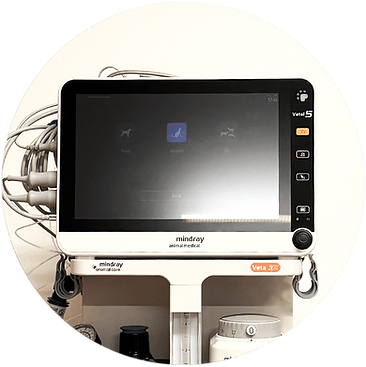
Thanks to its compact size, the Mindray VETA 5 vital signs monitor is well-suited for field veterinary medicine. The monitor tracks ECG, Resp, Temp, SpO2, and NIBP in real time, enabling the veterinarian to detect any deviation from normal in an anesthetized patient well in advance during surgery and intervene before complications become visibly apparent.
Inhalation Anesthesia
In veterinary medicine, inhalation anesthesia is generally regarded as a gentler and more easily controllable form of anesthesia in terms of depth, allowing animals to wake up faster and remain calmer afterward. The Mindray VETA 3X is among the most compact anesthesia machines available on the market. If needed, it can therefore also serve our veterinarians directly in our veterinary ambulance.
Portable dental unit
Here, we’d like to make a bold claim: we are (in all likelihood) the only team in the Czech Republic that can come directly to your home and provide your pet with comprehensive, professional dental care inside our large ambulance—which functions as a fully equipped minor operating room. This includes ultrasonic teeth cleaning, drilling, polishing, and extractions. It truly can’t get any more convenient.
Oxygen generator + oxygen box
In case of acute respiratory problems, we will connect your pet to a Philips EverFlo oxygen generator with a flow rate of up to 5 l (min. 93%) of oxygen per minute, which is sufficient even for an adult. For smaller animals, we also have an oxygen box without the need to wear a breathing mask. For larger animals, we have breathing masks in 6 different sizes.
Binocular video microscope
A laboratory microscope is still an indispensable tool in veterinary diagnostics. We also carry a binocular video microscope fromEuromex Hollandin our ambulances. It is not always necessary to perform (and pay for) expensive laboratory tests right away, and a veterinarian can often make do with a quality microscope.
A veterinary ambulance works in a similar way to an examination at your home, with the difference that the veterinarian will arrive at your home on the day of the booking (within 60 minutes within Prague) with a fully equipped veterinary ambulance, which functions as a mobile veterinary surgery, in which it is possible to perform the vast majority of veterinary procedures (various internal medicine, orthopedics, planned dental or surgical procedures, treatment after injuries, accidents or bites from other animals, caesarean sections, blood collection and examination, sonography, administration of infusions or medications, euthanasia including sanitation, etc.).
The price of transportation of a veterinary ambulance up to 2.5 t is 49 CZK/km, a veterinary ambulance up to 3.5 is 55 CZK/km, both from Prague 2, Pod Nuselskymi schody Street (both ways). In the case of a large ambulance (5.5 t) with a driver, it is 66 CZK/km (necessary in the case of examination, procedure or surgery inside the ambulance). In the event of booking a veterinary ambulance call-out after 6 pm, on weekends or public holidays, an emergency surcharge is charged according to the price list. The emergency surcharge according to the current price list is also charged for veterinary ambulance call-outs in emergency mode with a guaranteed arrival time of up to 90 minutes (usually within Prague within 60 minutes) after the confirmation of the date and payment of the deposit. The final price of the call-out depends on the set indicative prices of mobile veterinary services (+- 10%). When booking a veterinary call-out, the client is required to accept this price list .The radius of action and capacity of the veterinary ambulance are inherently limited and are therefore primarily intended for examinations and procedures that cannot be postponed for a longer period. The veterinary ambulance currently operates within the capital of Prague and the Central Bohemian Region within a driving distance of (approx.) 1.5 hours from Prague 2, Pod Nuselskymi schody Street. If you put "Pod Nuselskymi schody, Prague 2" as the starting point in your navigation system and your home address as the destination and the driving time is a maximum of 1.5 hours, the veterinary ambulance can arrive at your location and you can then make a booking using this link below. When ordering a veterinary ambulance, it is necessary to pay a deposit of CZK 2,000 in advance via the payment gateway card, Apple Pay, Google Pay) and once the departure date has been confirmed by us, it is no longer possible to cancel the departure free of charge. If the departure is cancelled after the date has been confirmed by us, the cancellation fee corresponds to the deposit paid so far. If the cancellation occurs while the veterinary ambulance up to 3.5 tons is already on its way to you, it is necessary to pay an additional transport fee of CZK 49/km (2,5 t) or CZk 55/km (3,5 t) in addition to the deposit, or CZK 66/km in the case of a large ambulance (5.5 tons) with a driver, both ways from Prague 2, Pod Nuselskymi schody Street. In the event that the veterinary ambulance is overloaded and its arrival cannot be ensured within an adequate time frame due to capacity reasons, the deposit you made will be refunded.
Our veterinarians are empathetic professionals in their field, and we also try to reward them sufficiently financially. Despite this, the price of the examination and medication is within the price range of regular treatment in the clinic that you are used to. The second component of the resulting price of the examination is the transportation, which is CZK 49/km both ways in case of an ambulance up to 2.5 t, CZK 55/km in case of an ambulance up to 3.5 t, and CZK 66/km both ways in case of a large ambulance (5.5 t) for examinations, procedures and operations inside the ambulance from Pod Nuselskymi schody street in Prague 2. The expected price of the trip depends on the set indicative prices of mobile veterinary services (+- 10%). When ordering a veterinary ambulance dispatch, the client is required to accept this price list (see here).Therefore, after submitting the order form, you will be automatically redirected to the payment gateway for the purpose of paying the deposit for home visit in the amount of 1000 CZK (by card, Apple Pay or Google Pay) or 2000 CZK for the veterinary ambulance dispatch. From experience, we know that this is usually the lower limit of the total price of a home examination. If the total price of the examination is higher (consumables, medication, higher time requirements, longer distance, etc.), the resulting price will be reduced by this amount. The paid deposit also serves as a deposit in case of cancellation of the scheduled examination less than 48 hours in advance (see more below).
Yes. We are a contracted partner of the largest pet insurance company, PetExpert, which in most cases reimburses the cost of the examination within 10 minutes of the claim being submitted by our veterinarian right after the examination (the owner thus pays only a 10% deductible on site).*f you do not have PetExpert insurance yet, you can sign up HERE, and if you enter the partner code "18001495" in the final step, you will receive 2 months of insurance completely free upon activation.**Insurance companies Generali, Direct, and Colonnade do not have a partner network and cover veterinary expenses retrospectively for treatments by any veterinarian. The client therefore pays the veterinarian for the treatment and subsequently claims the paid amount from their insurance company.* * BEWARE: Insurance companies generally do not cover travel costs and emergency surcharges (see specific policy terms).
** Waiting periods for coverage are 3 days for accidents, 30 days for illnesses, and 6 months for specific orthopedic diagnoses.
The veterinary ambulance service, veterinary visits to patients' homes and remote examinations via telephone (telemedicine) operate on weekdays, weekends and public holidays from 8:00 a.m. to 8:00 p.m.An ambulance call-out can be also booked in advance outside of the above-mentioned working hours.
Unfortunately, it is not possible to provide an exact price quote in advance (except for a clearly defined scope of services - e.g. vaccination or euthanasia), because veterinary treatment and follow-up procedures are tailored to the individual condition of the patient. Your pet is a living creature with its own individual needs and concerns. The total estimated price of a veterinary visit depends on the valid price list of veterinary services (+- 10%) and confirmation is required from the client when placing a booking (see here). Therefore, we will always ask you to pay a deposit of CZK 1,000 in advance for the veterinarian's visit, and you will then find out the final price of the examination after it has been performed.
Of course, we understand that sometimes something unforeseen can happen and you cannot keep the agreed date. If it is ever necessary, you can reschedule your home examination for another day free of charge up to 48 hours before it starts. You can do this easily via email or by phone (you can find everything in the Contacts section). In such a case, please change your date as soon as possible so that we can offer it to another furry friend. 🐱 🐶If you cancel or reschedule your exam less than 48 hours before it starts, we reserve the right to charge a fee (see below) as we are usually unable to replace a canceled exam at such short notice.Cancellation conditions when canceling or rescheduling an examination at your home or via telemedicine:Less than 48 hours before the date - 50% of the deposit paidLess than 24 hours or no-show - 100% of the deposit paidFor veterinary ambulance services for emergency cases and examinations on the day of booking, the cancellation fee is the amount of the deposit paid. This fee is charged when canceling the trip after we have confirmed the date (by SMS or by sending an invitation to Outlook/Google calendar by e-mail).
Remote examination in the form of so-called telemedicine (call/video call, analysis of symptoms from sent photos or videos, recommendation of further procedures) is an increasingly popular form of initial examination, which is sufficient in up to 60% of all cases and thus saves you time and money. It is suitable for common non-emergency cases such as rashes, allergies, colds, diarrhea, loss of appetite, apathy, movement or dermatological problems, etc., where after establishing a diagnosis, the veterinarian will recommend further procedures and possible medication.On the other hand, this form of examination is unsuitable in cases of an emergency nature (bleeding, choking, poisoning, unconsciousness, gastric dilatation and volvulus,, etc.), when time is of the essence and the physical presence of a veterinarian with the necessary equipment and medication is absolutely necessary for timely intervention and saving your animal friend.
For an examination at your home or a veterinary ambulance call-out, it is necessary to make a non-cash deposit of CZK 1,000 or CZK 2,000 via a payment gateway (card payment, Apple Pay or Google Pay).For a remote veterinary examination via telemedicine, you will also pay the amount of CZK 500 cashlessly via a payment gateway before the examination takes place.The estimated cost of the visit depends on the set indicative prices of mobile veterinary services (+- 10%). When ordering a veterinary visit, the client is required to accept this price list (see here). You will find out the final price of the examination after it is completed (depending on the complexity of the examination, distance traveled, consumables and medication used) and you will pay the resulting price, reduced by the deposit, by credit card, QR payment or in cash.
Our veterinary ambulances do not function only as transport vehicles. They are professionally built units in which, in addition to basic veterinary equipment and medicines, animals can be safely stabilized, connected to an oxygen generator, transported and, in the case of our large ambulance (5.5 t), also operated on. You can learn more about our equipment here.
Veterinarians from Sonda.cz treat all common pets. Primarily dogs and cats, but some of them also treat rabbits, guinea pigs, hamsters, ferrets, etc. Only a handful of them treat birds, reptiles, amphibians, farm animals and other large mammals. If you need to treat a pet other than a dog or cat, please indicate its exact species when filling out the form so that we can provide the right animal doctor for it. 🐰🦜🐹
The Sonda.cz is growing every week and adding new places that have not yet been covered. When filling out the form for a veterinary examination at your home or a veterinary ambulance call-out, you will see the regions in which we currently operate (this does not apply to remote examinations in the form of telemedicine). If you do not see the region in which you live in the selection, it means that we do not operate there yet. However, we are constantly trying to recruit new veterinarians so that we can cover the entire Czech Republic as soon as possible. So what we do not cover today may be covered in a month. 🙂
Yes, you certainly can. If you wish to examine more than one of your pets at the same time, please let us know in the examination booking form.
Whether you want an examination at home, veterinary ambulance dispatch or remotely via telemedicine, the procedure is always the same. Simply click the booking form, enter your contact details and your pet's details, select your preferred examination date and pay for the examination via the payment gateway (by card, Apple Pay or Google Pay). You will then receive a confirmation of the appointment with all the information.
On the day of the home examination, please be home at least 30 minutes before the scheduled examination. Our veterinarians do their best to adhere to the specified time frame for the examination, but from time to time they may be a little late due to traffic conditions or a complicated previous examination. Some simpler examinations will take, for example, 20 minutes, while more complex ones can take up to 2 hours. So please allow enough time after the scheduled examination.If your pet likes to hide, place it in a room where this is not possible (e.g. bathroom), or in a transport bag or cage. If you know that your pet can be aggressive, prepare a muzzle and collar with a leash for a dog, and a large towel or blanket for a cat. If you have any records/reports about its previous illnesses, examinations or blood tests, etc., prepare these as well.
Once the veterinarian arrives at your home, the medical history begins and you can tell him everything you need to know about your pet's medical or psychological condition.As a rule, regardless of the primary reason for the trip, a basic clinical examination of the patient (eyes, ears, oral cavity, abdominal cavity, nodes, spine, limbs, etc.) will be performed, which will provide the veterinarian with a rough initial picture of your pet's health.During the examination, you may be asked to assist the veterinarian with treatment if necessary, e.g. to hold or pet the animal, etc.During a telephone consultation, the veterinarian will determine the likely diagnosis and recommend further action, including possible medication or the need for a physical examination of the patient, or a visit to a specialist.If you have any questions during the examination, do not hesitate to ask the veterinarian anything.
Based on the type of examination requested, we always select a veterinarian who can best help your pet and can arrive at the time you request. Rest assured that all veterinarians from Sonda.cz meet our high quality standards, have many years of experience and do their job with love and empathy. 💚
Our clinic is located at Pod Nuselskymi schody 1721/3, 120 00, Prague 2 - Vinohrady and is open every day from 9 am to 8 pm, including weekends and public holidays.
Theoretically, you don't have to, but you should expect that all patients in the waiting room who have booked an examination in advance (and paid a deposit for it) will be treated first. The only exception is the priority admission of an emergency patient, who is charged an emergency surcharge according to the price list.
There are several ways to prepare for a remote examination in the form of telemedicine. If you have a smartphone, everything can be done on it. If it is relevant to the planned type of examination, it is ideal to take high-quality photos or even better a video in advance, from which the symptoms or changes in your pet's behavior will be clearly visible and then add them as an attachment when filling out the order form or send them to us, for example, by email as a reply to the confirmation email you receive from us. You will then contact the veterinarian either by phone or by video call (WhatsApp/Skype/Google Meet/Zoom, etc.). In this case, it is necessary to have an account set up in advance with at least one of these services. The veterinarian will then discuss everything with you and recommend the next step. It is important to have a good signal in the case of a phone call and a fast and stable internet connection in the case of a video call. 📱📞The same can be done via your computer, when you connect to the online meeting (WhatsApp/Skype/Google Meet/Zoom, etc.) via the link in the email we will send you in advance - you must have an account set up with at least one of these services in advance). It is important that you have a sufficiently fast and stable internet connection (for example, not far from a wifi router at the time). If the video call "hangs", the veterinarian will have no choice but to try to contact you by phone. Therefore, it is better to have photos or videos of your pet prepared in advance, if desired, and send them to us well in advance before the planned online meeting, e.g. by email or WhatsApp. 🖥️ 💻
Yes, it is very helpful if you let us know in advance what medications your pet needs or what medications the vet should bring with them. If you did not do this during the booking process (when filling in your pet's information), you can do so afterwards via email.
Please allow plenty of time for your pet's home exam. The length of the visit will depend on the treatment and behavior of the pet. For shorter treatments, the appointment can be completed in as little as 20 minutes. More complex treatments can take up to 2 hours.Our veterinarians do their best to arrive at your home and your four-legged friend on time. Of course, there may be delays due to transportation or time-consuming treatment of another pet before your appointment, so please allow at least 60-90 minutes for your scheduled examination.